
 Facebook
 X
X LinkedIn
 Forward
Advanced Surgical Skills for Exposure in Trauma (ASSET) 2nd Edition
Developed by the American College of Surgeons Committee on Trauma, the Advanced Surgical Skills for Exposure in Trauma (ASSET) course is a standardized one-day, fresh cadaver–based surgical skills program designed to teach the operative exposures required for rapid hemorrhage control and trauma management. Introduced in 2010, the course emphasizes that surgical exposure is the critical first step in controlling major vascular injury.
Conducted entirely in the cadaver laboratory, ASSET uses a case-based, scenario-driven format to teach exposure of the major vascular structures of the neck, chest, abdomen, pelvis, and extremities, along with fasciotomies and pelvic packing. The curriculum includes an illustrated manual, narrated procedural videos, faculty teaching materials, and standardized assessment tools developed through expert consensus. The course is intended for senior surgical residents, trauma and critical care fellows, military surgeons, and practicing surgeons who may encounter traumatic injuries but do not routinely perform trauma surgery.
ASSET is taught with a 4:1 student-to-faculty ratio and focuses on operative anatomy, technical exposure skills, and confidence in managing life-threatening hemorrhage. The course has been widely adopted in civilian residency programs, military readiness curricula, and pre-deployment training worldwide.
Contact
For any questions about the ASSET course, please contact us [email protected]
Target Audience
The ASSET course is intended for:
- Senior surgical residents
- Trauma fellows
- Military surgeons
- Fully trained general surgeons who are not frequently called on to treat penetrating injuries
Learning Objectives
At the end of this educational activity, participants will be able to...
- Apply knowledge of key anatomical exposures for the care of acutely injured surgical patients.
- Demonstrate technical ability to expose important structures that may require acute surgical intervention to save life or limb.
- Perform anatomic exposures independently.
Course summary
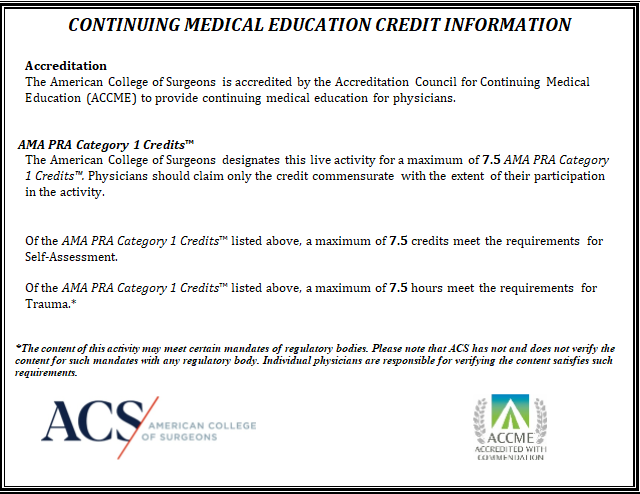
- 7.50 AMA PRA Category 1 Credit™
- 7.50 Certificate of Completion
- 7.50 Self Assessment Credit
DISCLOSURE POLICY
In accordance with the ACCME Accreditation Criteria, the American College of Surgeons must ensure that anyone in a position to control the content of the educational activity (planners and speakers/authors/discussants/moderators) has disclosed all financial relationships with any commercial interest (termed by the ACCME as an “ineligible company”, defined below) held in the last 24 months (see below for definitions). Please note that first authors were required to collect and submit disclosure information on behalf of all other authors/contributors, if applicable.
Ineligible company: Any entity producing, marketing, re-selling, or distributing health care goods or services used on or consumed by patients. Providers of clinical services directly to patients are NOT included in this definition. |
Financial Relationships: Relationships in which the individual benefits by receiving a salary, royalty, intellectual property rights, consulting fee, honoraria, ownership interest (e.g., stocks, stock options or other ownership interest, excluding diversified mutual funds), or other financial benefit. Financial benefits are usually associated with roles such as employment, management position, independent contractor (including contracted research), consulting, speaking and teaching, membership on advisory committees or review panels, board membership, and other activities from which remuneration is received, or expected. |
Conflict of Interest: Circumstances create a conflict of interest when an individual has an opportunity to affect CME content about products or services of an ineligible company with which he/she has a financial relationship. |
The ACCME also requires that ACS manage any reported conflict and eliminate the potential for bias during the educational activity. Any conflicts noted below have been managed to our satisfaction. The disclosure information is intended to identify any commercial relationships and allow learners to form their own judgments. However, if you perceive a bias during the educational activity, please report it on the evaluation.
For course-specific disclosure listings, please refer to the disclosure insert provided at your course site.
ASSET Planning/Development Committee Disclosures:
Mark Bowyer, MD, FACS, FRCS (Glasg)
No relevant financial relationship(s) with ineligible companies to disclose
Daniel Grabo, MD, FACS
No relevant financial relationship(s) with ineligible companies to disclose
Eric Kuncir, MD, FACS
No relevant financial relationship(s) with ineligible companies to disclose
Neil Parry, MD, FRCSC, FACS
No relevant financial relationship(s) with ineligible companies to disclose
Successful completion of this CME activity, which includes participation in the evaluation component, enables the learner to earn credit toward the CME and Self-Assessment requirements of the American Board of Surgery’s Continuous Certification program.
Through an agreement between the American College of Surgeons and the Royal College of Physicians and Surgeons of Canada, MOC Program participants may record completed self-assessment programs or simulation activities developed and accredited by the American College of Surgeons in Section 3 of the Royal College's MOC Program.

Available Credit
- 7.50 AMA PRA Category 1 Credit™
- 7.50 Certificate of Completion
- 7.50 Self Assessment Credit